

An academic essay is a focused piece of writing that takes a clear position, builds it through evidence, and explains why that position holds up under close reading. Writing academic essays typically asks the writer to draft a quick outline, develop the thesis statement, build the body paragraphs where each point is proven with evidence, and close with an insightful conclusion.
The following article discusses the structure, formatting rules, examples, how to write an excellent academic essay, and the most common mistakes that cause students to end up with weak essays.
What Is an Academic Essay?
An academic essay is an organized, formal argument centered around one main point. The purpose of an academic essay is to demonstrate the author's ability to think critically about a topic, link together multiple ideas, and use credible sources as evidence for the central claim. As you write, you must determine what information is relevant, what can be excluded from use in the essay, and what the purpose of the individual paragraphs will be. The unique characteristics of an academic essay are as follows:
- Length: The essay should meet the required word count or page limitation.
- Clarity: The writing must be concise, well-organized, and easy to understand. Using complex language will not, in itself, create a better essay.
- Topic: The topic must be narrow enough to allow for a real discussion to take place. If a topic is too broad, you will be restricted to surface-level comments and will ultimately create a weaker paper.
- Central Idea: The thesis is the center of the overall structure. Every paragraph should connect back to that idea in a clear and purposeful way.
- Personal Motivation: The author's interest plays an important role in determining the kinds of questions that will be asked. A paper that lacks personal interest from the author will often sound flat, even when the grammar is fine.
- Evidence: The strongest features of an academic essay include credible sources, examples, data, and close analysis. Evidence should never sit there like decoration; it has to do real work for the argument.

Essays Due Soon?
Hand the hard part to expert sand get back a polished, ready-to-submit paper on time!

Types of Academic Essays
Academic essays are usually grouped by purpose. A narrative essay presents an experience, a descriptive essay examines details, an expository essay explains a subject, a persuasive essay supports a position, and an argumentative essay defends a claim with evidence. Writing academic essays becomes clearer when the writer understands the goal of the assignment first.
Narrative Essay
A narrative essay tells a story, but that story must have some kind of academic tie. The order of the events is important, but it is still a secondary concern because reflection matters a lot more. Regardless of what your paper stems from (a personal experience, a turning point, a moment that revealed something life-changing), the reader needs to understand the experience and why it is significant enough for them to read about.
Xintian Tina Wang on storytelling in essays and applications will better teach you how to use reflection to structure a well-written academic essay.
Descriptive Essay
A descriptive essay uses detail to describe a subject's characteristics and features more clearly. The subject could be a location, an item, a person, an event, or a memory. As you learn how to write a descriptive essay, you must be very selective in the types of details you include in the paper. Random adjectives will derail the entire point of providing one main impression.
Expository Essay
An expository essay describes something. That sounds like it would be simple, but as soon as essay topics start to branch out in five different directions, it can become complex to write about. An expository essay may define or compare concepts/ideas, describe a process, break down into sections/subsections. In an expository essay, the writer’s opinion is irrelevant. You must present factual evidence and supporting examples.
Persuasive Essay
A persuasive essay argues for a position and tries to convince the reader of the writer's opinion. As you write a persuasive paper, you must carefully build and use supporting evidence, reasoning, and argument. Good persuasive writing focuses on the audience. The writer builds enough trust (through concrete evidence, of course) for the reader to keep reading the writer's viewpoint. The right persuasive essay topics will make it a lot easier for you to draft a confident paper.
Argumentative Essay
An argumentative essay presents an argument, as the title suggests, using research to support it. You also must directly address the opposition to the argument. The evidence in this type of paper must be stronger than that of a simple persuasive essay. Your goal is to show that your argument is strong enough to survive the pressure from the opposing side. A well-written argumentative essay will feel steady, stable, and difficult to push over.
Academic Essay Format
The academic essay format makes sure the layout of the paper is just as professional as the contents. Here are the main details you should keep in mind:
.webp)
- Five-Paragraph Structure: Many academic essays follow a simple structure with an introduction, three body paragraphs, and a conclusion.
- Font Style and Size: Times New Roman, Arial, or Calibri in 12-point size.
- Double Spacing: Double spacing across the entire document, including quotations and references.
- One-Inch Margins: Standard one-inch margins on all sides keep the page balanced.
- Paragraph Indentation: First line with a half-inch indent.
- Page Numbers: Most formatting styles require page numbers in the header.
- Title Placement: The title should sit clearly at the top of the first page.
- Citation Style: MLA, APA, or Chicago style, depending on the field and its requirements.
- Consistent Headings: Longer essays may include section headings that guide the reader through the argument.
Academic Essay Outline
Writing an academic essay, much like any other kind of paper, starts with an outline. It shows what each section should do before the draft makes those decisions for you. A clear outline also helps you see weak logic early, when fixing it is still simple.
- Introduction
- Hook: Open with a sentence that gives the reader a reason to care. This may be a sharp fact, a brief situation, a surprising detail, or a question with real weight.
- Background Information: Give enough context for the topic to make sense. Define key terms, name the issue, or explain the situation behind the argument.
- Thesis Statement: State the main claim of the essay. The thesis should be specific enough to guide every paragraph.

- Main Body
- Point 1: Evidence + explanation + example
- Point 2: Evidence + explanation + example
- Point 3: Evidence + explanation + example
- Conclusion
- Summary: Briefly recap the main ideas without repeating whole sentences.
- Restatement: Return to the thesis in fresh wording.
- Final Sentence: End with a clear closing thought that leaves the reader with something useful, specific, and complete.
How to Start an Academic Essay
The start of an essay has to instantly give the reader a reason to keep going. It should set the context and point toward the argument without dragging its feet. Here's how to write an essay introduction:
- Hook: Write an opening line that pulls the reader toward the topic. It can create tension, raise a problem, or reveal a detail that makes the subject feel worth attention.
- Background Information: Add the context the reader needs before the argument begins. Define the issue, name the wider discussion, or explain the situation behind the topic.
- Thesis Statement: State the main claim in one clear sentence. A strong thesis gives the essay a spine. It should be specific enough to control the body paragraphs and arguable enough to need proof.
- Transition Into the Main Idea: Move naturally into the essay’s first body point. The introduction should feel like a path, not a trapdoor.
Hook, as we said, should give the reader a reason to keep reading the paper, so it should pull them in almost immediately. The trick to a good academic essay introduction example is to choose the right fit to the paper’s purpose instead of sounding decorative.
- Quote: Use a short, relevant quotation that sharpens the topic or frames the issue. A famous line needs a real reason for being there.
- Fact: Another common strategy for opening is to start with a concrete fact that gives the subject instant context. Plain facts, as long as they're relevant, have more weight than dramatic phrasing.
- Statistic: A number can show scale, risk, change, or impact. A statistic works best when the next sentence explains why it matters.
- Rhetorical Question: A question that points directly toward the essay’s central concern is also an effective opener. The question should feel thoughtful, not like filler before the real writing begins.
How to Write the Body of an Academic Essay?
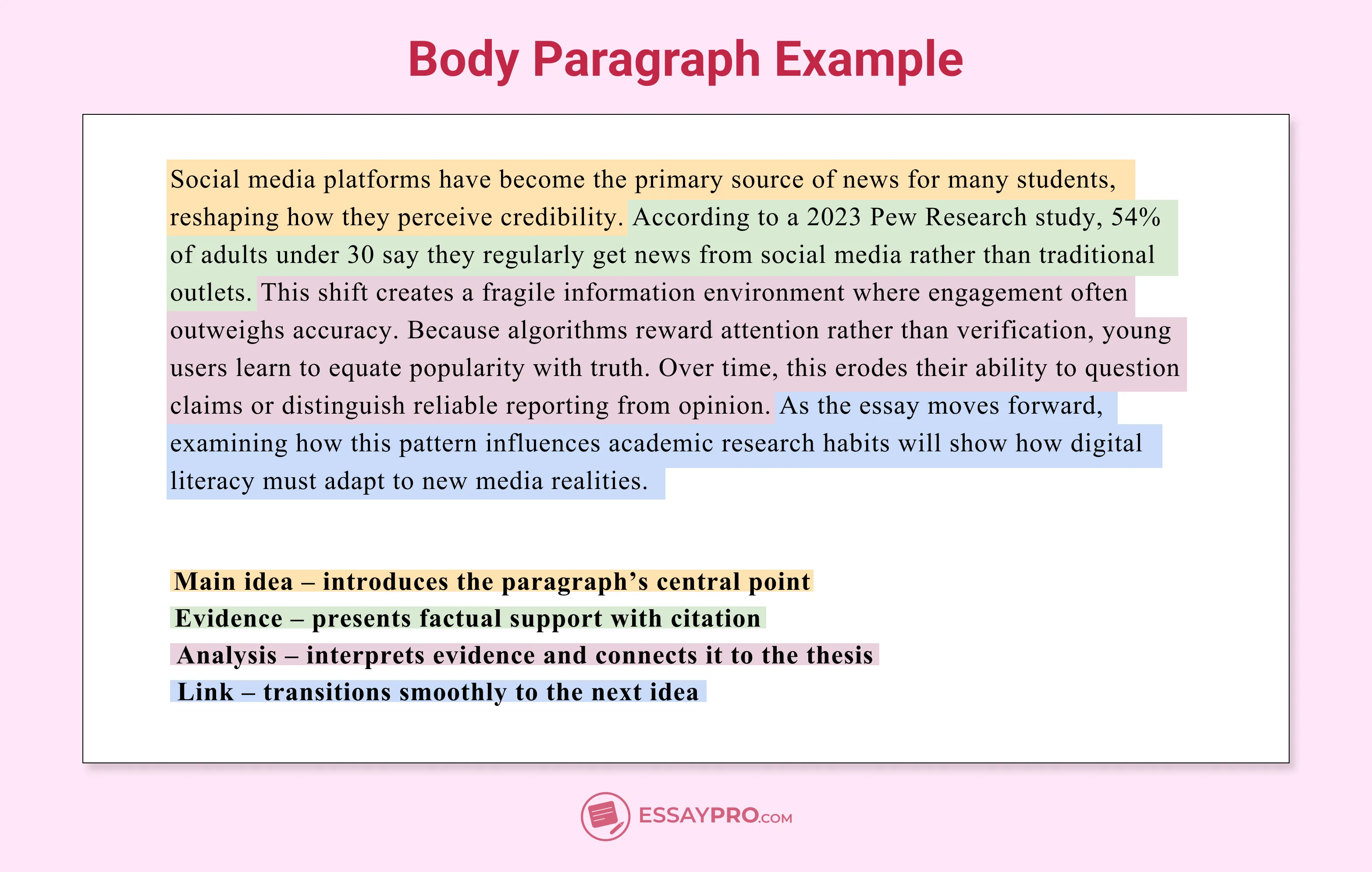
The body is the part where a claim has to earn its place. A paragraph can have a clever sentence and still do almost nothing if the evidence is there without any explanation. The writer has to look carefully at the proof and understand what it actually points to, so the reader can understand it as well. If you want to build an effective academic essay body paragraph example, here’s what you should include:
- Topic Sentence: Name the exact claim this paragraph will develop. It should answer one question: what part of the thesis is being tested here?
- Evidence: Bring in material that can actually support the claim. A quote, statistic, study, example, or close reading works only when it directly answers the paragraph’s point.
- Explanation: Do the thinking after the evidence. Explain what the evidence shows, which detail matters, and why the reader should accept your interpretation.
- Connection to Thesis: Make the paragraph’s role in the larger argument visible. The reader should see how this point advances the essay, not just the paragraph.
- Transition: Shift into the next idea by showing a logical relationship. The next paragraph may extend the point, complicate it, or move the argument into a new stage.
How to End an Academic Essay?
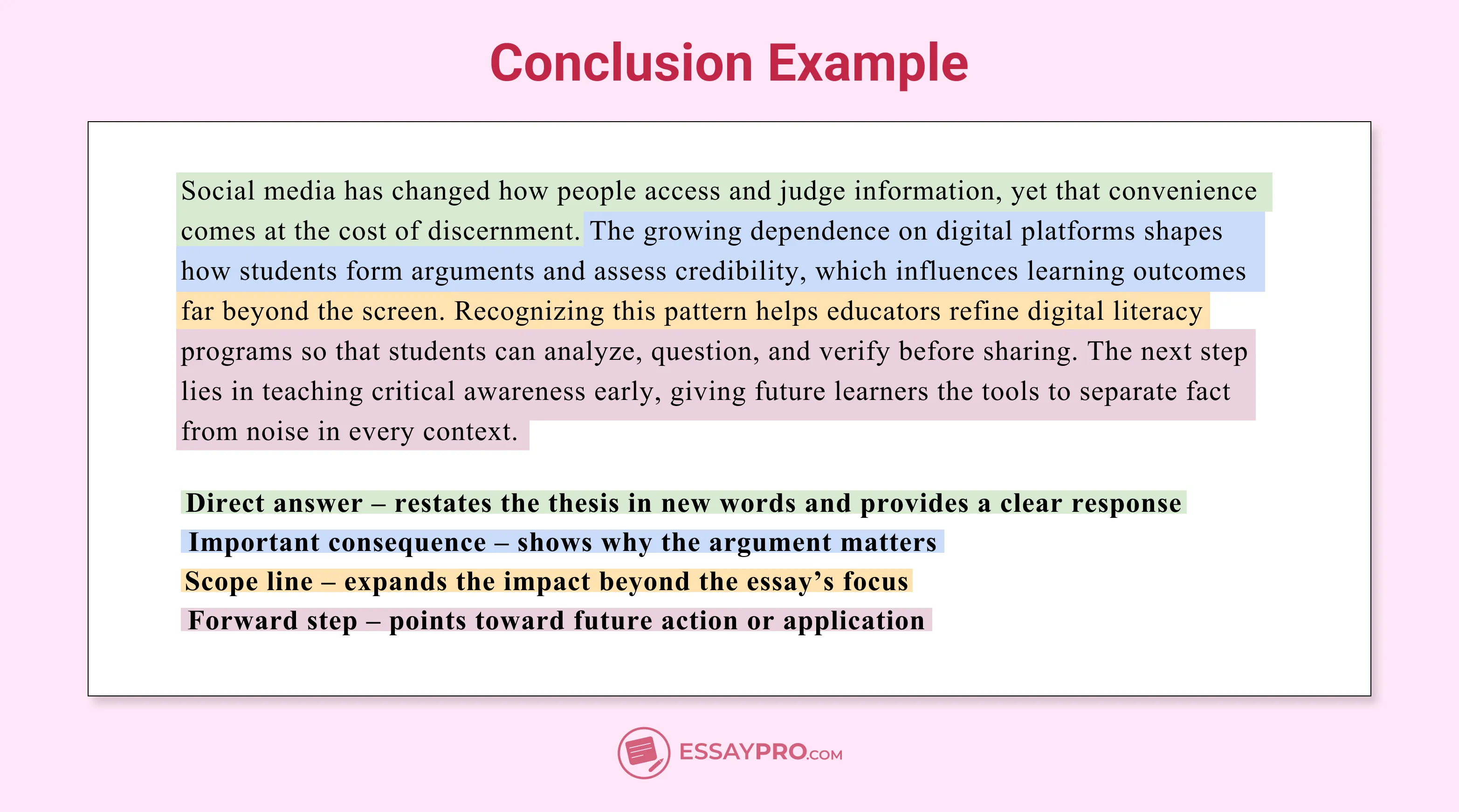
An academic essay conclusion example should show how the argument has developed and why the final point matters. A weak ending usually repeats the introduction in flatter wording or adds a vague sentence about the topic’s importance. A strong conclusion returns to the thesis with more control, connects the main findings, and gives the reader a clear sense that the argument has reached its proper end.
- Restated Thesis: Return to the main argument in fresh wording. The conclusion should remind the reader of what the essay proved without copying the introduction sentence by sentence.
- Summary of Main Points: Briefly revisit the strongest ideas or findings from the body paragraphs. Keep it focused. A conclusion should not drag every detail back onto the stage.
- Final Insight: End with a thought that widens the discussion slightly, points toward a larger implication, or leaves the reader thinking about the topic differently.
- Sense of Closure: The ending should feel finished. Sudden endings are too abrupt and make the reader think a whole paragraph is missing.
Academic Essay Example
A strong academic essay example should show structure clearly without turning the paper into a worksheet. The perfect example of academic essay below shows exactly what belongs where and how the arguments must be supported.
Topic: Why Libraries Still Matter in Buildings Filled With Smartphones
[Introduction] Most people carry more information in their pocket than a library shelf could hold twenty years ago. That shift changed how students search, read, and prepare for assignments. Still, libraries continue to attract people who already have constant internet access. Modern libraries remain important because they provide structured environments for concentration, reliable research materials, and public spaces designed around focused study.
[Body Paragraph 1] Libraries create conditions that support sustained attention. A phone gives students quick access to information, but it also brings constant interruptions through notifications, advertisements, and recommendation feeds. A library changes the conditions around the work. Quiet rooms, shared expectations, and limited distractions make it easier for students to stay with difficult reading or research for longer periods.
[Body Paragraph 2] Libraries also give students access to more reliable research materials. Search engines often reward speed, popularity, and surface relevance. Academic databases follow stricter standards. Peer-reviewed journals, archived sources, and librarian guidance help students work with evidence that has passed through evaluation before it reaches their paper.
[Body Paragraph 3] Public libraries also serve students who need stable places to work. A library offers internet access, desks, research support, and a quiet space without requiring a purchase. That matters in cities where many public spaces are built around buying something. For students without a quiet room at home, the library can become the difference between interrupted work and serious progress.
[Conclusion] Libraries continue to matter because they support concentration, improve research quality, and protect access to study space. Smartphones changed how students reach information, but they did not remove the need for places built around serious reading and sustained thought.
If you still prefer a professional to go over your more important projects, you can always buy a dissertation from EssayPro.
Academic Essay Writing Tips
A well-written academic paper can't usually be completed in one draft. The initial version is intended to get the basic ideas on the page, while later ones will help you determine which ideas are worth keeping. Here are a few additional tips you can follow to make sure your essay is proper:
- Draft with structure first: Use the outline to build the first version. The first draft should contain a thesis, ideas arranged in logical order, and the evidence you will use to support your argument.
- Cut weak material: Remove details that repeat the same point or drift away from the essay topic. By doing so, your draft will quickly become more effective
- Revise for logic: You should make sure that all of the ideas discussed in each paragraph support the argument and relate back to your thesis statement.
- Choose precise words: You should use the correct vocabulary for the subject of your paper to make sure that your writing makes sense to your intended audience.
- Polish before submission: Edit for grammatical and punctuation errors, as well as citations, bibliography, and formatting mistakes, before you turn in your final draft.
Essays Due Soon?
Hand the hard part to expert sand get back a polished, ready-to-submit paper on time!
The Last Word
Academic essay writing becomes easier when the process has order. If you're short on time or need extra support, you can write my essay online with help from EssayPro experts. Start with a focused topic, build a clear thesis, outline the structure, develop body paragraphs with evidence, and end with a purposeful conclusion.
FAQs
How to Structure an Academic Essay?
What Is the Format of an Academic Essay?
How to Write an Academic Essay Introduction?
How to Write an Academic Essay Step by Step?
How to Conclude an Academic Essay?

Daniel Parker
is a seasoned educational writer focusing on scholarship guidance, research papers, and various forms of academic essays including reflective and narrative essays. His expertise also extends to detailed case studies. A scholar with a background in English Literature and Education, Daniel’s work on EssayPro blog aims to support students in achieving academic excellence and securing scholarships. His hobbies include reading classic literature and participating in academic forums.

.webp)